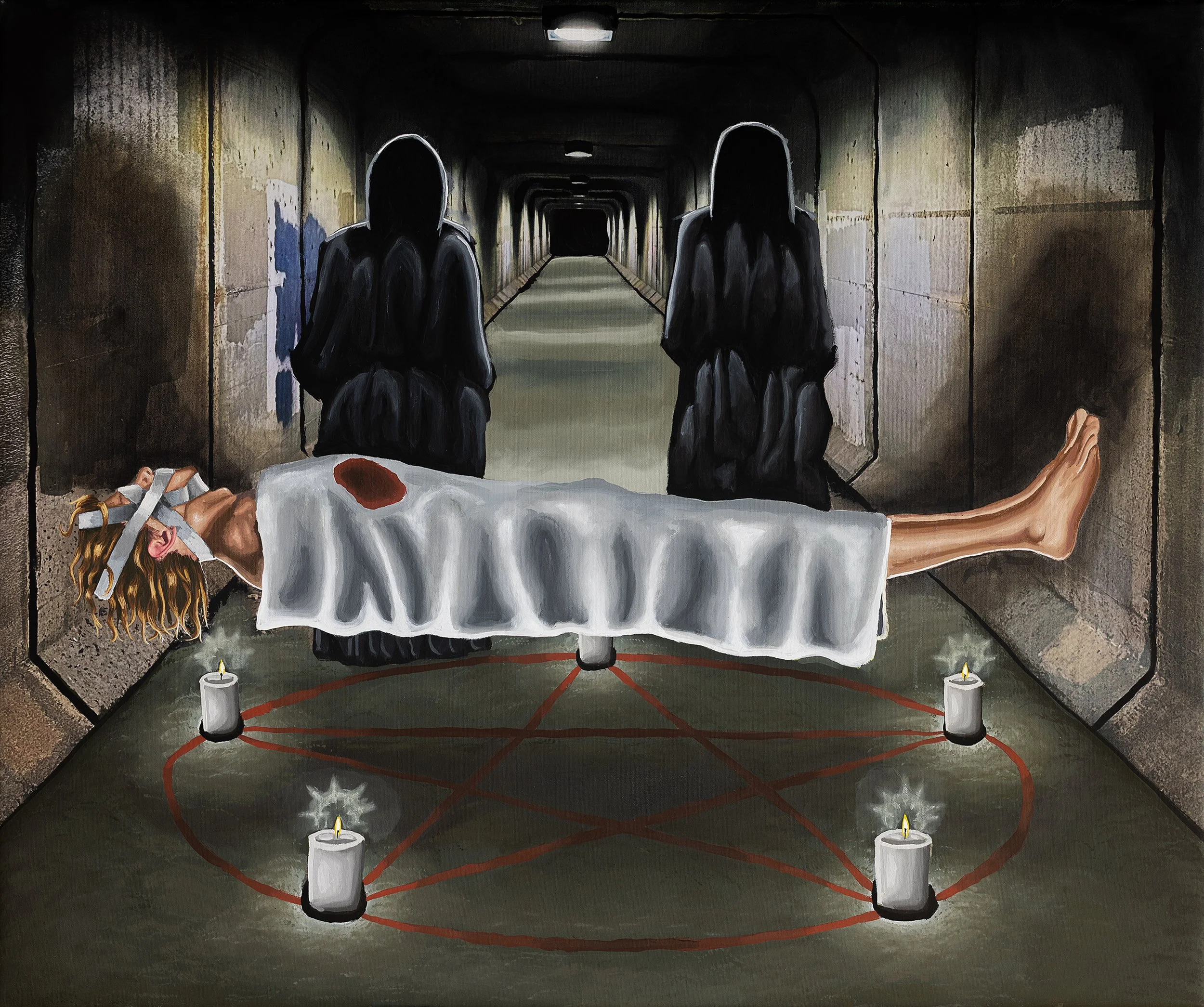
The Devil You Don’t |2026
20 by 20 Inches Oil on Printed Exhibtion Canvas
While True Crime is rampant with baseless speculation, there is a subculture that relies entirely on imagined crimes. The conspiracist sect of true crime communities take to constructing intricate theories of blood libel, secret societies, and criminal organizations operating in plain sight. The most contemporary example of the conspiracist sect is QAnon, a digital cult of accusation. QAnon began as message board which found its home on a website called 8Chan. The group is led by Q, a pseudonymous account which followers believe to be a high-ranking intelligence officer who offers privileged intel he obtains using his “Q-Level Security Clearance.” As a digital pseudo-religion, Q takes the role of the oracle, who dispenses information from the cult’s messiah, which is President Donald Trump. Below Q is a group of dedicated followers dubbed “bakers”, who assign themselves the role of deciphering the cryptic “breadcrumbs” released in so called “Q-drops.” QAnon claims that there is a secret society of world-elites who traffic children, eat babies, worship Satan, and harvest a chemical called adrenochrome by torturing trafficked children. There are countless more theories about how this operation is accomplished, each one more nonsensical than the last. QAnon followers believe that Donald Trump is at war with this criminal organization and will eliminate them in an event called “the storm”. But to attempt to understand QAnon as a centrally controlled community with an unchanging doctrine is to misunderstand QAnon as a belief system. If anything, QAnon is a mindset of suspicion, but not skepticism. Because the intel provided by Q is unclear, the followers are responsible for discerning the hidden meaning of his posts, and the conclusions they come to are both folkloric and psychotic. Because their suspicions are so absurd, what qualifies as evidence is equally nonsensical. For instance, listings for expensive furniture that includes human names by online retailer Wayfair is concrete proof that Wayfair is trafficking children through their furniture business. (Q: Into the Storm) You might wonder why it is that Wayfair does this in plain sight; you might question whether one of these ‘detectives’ has attempted to purchase the furniture in order to save the children who are assumed to be trapped inside. If you’ve questioned this at all, you have already accomplished an extraordinarily greater amount critical thinking than is employed by QAnon followers. While it is entertaining to poke fun at the idiocy of this group, the truth of this phenomenon is much more frightening. At the height of QAnon’s popularity, 10% of the population was estimated to believe in the conspiracy theory. (VICE) It should concern all of us that 1 out of 10 people are psychotic and likely dangerous. Let us not forget that QAnon followers are more than likely to own guns. Psychology Journals differentiate conspiracy theory belief from delusions or psychosis on the basis that these are believed by many and therefore lie outside diagnostic criteria which requires false beliefs to be rejected by nearly everybody. (Veling et al.) I find this distinction arbitrary. Why does the prevalence of a delusional belief negate its delusional nature? QAnon followers certainly display various symptoms related to delusional and psychotic disorders. They have a persecutorial delusion that a cabal of satanic cannibals is conspiring against them. They have delusions of grandeur; they believe they have alone have access to privileged information and that the president is speaking to them through code. They find deep significance in utterly meaningless events, such as expensive furniture listings. And above all, they believe in Satan and a group of world leaders who have pledged allegiance to him. These delusions come at great cost to those who maintain them. Some are estranged from friends and families after conspiracy theories become all-consuming. Some act violently, because the existence of a child trafficking cabal demands that they intervene. Conspiracy theories are self-rationalizing and unfalsifiable. Contrary evidence is a part of a cover-up, official vindication is a part of further deception, and unfulfilled prophecies are only delayed. This is what makes QAnon a disbelief system, because more important than what they believe is their certainty that reality as they see it is fake. They are paradoxically impressionable and vulnerable to misinformation and simultaneously immune to rational persuasion. The quality of their belief is that of a non-Newtonian fluid, always tentative and shapeless, but suddenly rigid and steadfast when struck by empirical verdict. I see no reason as to why this does not qualify as a highly prevalent mental illness, one that just so happens to be politically motivated. Belief in QAnon should be more than enough reason to involuntarily commit someone to a mental health institution. These people are insane, and conspiracist groups have produced several domestic terrorists including Edgar Maddison Welch, Matthew Coleman, Anthony Carmello. Politicians like Nancy Mace and Marjorie Taylor Greene who endorse QAnon should not only be impeached but should be barred from owning firearms and confined to psychiatric institutions. QAnon is yet another form of blood libel myths which have historically been leveraged as part of antisemitic persecution, but QAnon is more generous in their interpretation, including anyone who is non-white, queer, or politically progressive. Although conspiracies are a vehicle for bigotry, it is evident that QAnon followers truly believe in the most absurd extremities of their world view. This conspiracist sect is of course a spectrum, but that spectrum ranges from delusional at one end to outright hallucinatory on the other.
Stories of satanists and ritual abuse have been a staple of American culture since the colonial period. Though the satanic conspiracy seems obviously absurd, to the nation’s largely Christian population, paranoid suspicion is the next logical conclusion of dualist belief. A large portion of America believes in two living embodiments of good and evil, warring over the souls of everyone on earth. These embodiments have armies of supernatural beings, and every person on earth is an agent for either good or evil. Conspiracists are steadfast in their belief that they are essentially good, and therefore anyone opposed to them in any way is an agent of evil. Their god of goodness is endlessly good, and thus it reasons to believe that the evil god and its agents are endlessly evil. Part of the good agent’s goodness is in their self-denial, their prudence, which requires them to concede desire for evil. Uncomfortable with the idea they want to do evil, they must imagine what Evil truly desires is beyond comprehension. They tell of cannibalism, child sex abuse, torture, they talk of feasting on children’s fear.
It important to note the fact that there are no satanists. Apart from the mentally ill or sarcastic atheists there is no one who believes in and devotes themselves to Satan, who, by Satan’s own admission, is inferior in strength to the Christian god. Conspiracists’ world view is terrifying, and evidently self-destructive. The inclination towards satanic conspiracy is evidence of a subconscious desire to ascribe deeper meaning to suffering. The need to make such crimes exotic and spectacular is emblematic of this rationalization. Though it seems illogical, there is comfort in the idea that criminals act not out of sadistic gratification, but in the appeasement of the ontological embodiment of evil. The satanic panic of the 80’s and 09’s was a mass hysteria event almost identical to the Salem witch trials of the 1690’s. Perpetrators were thought to be in league with devil and no evidence was needed for accusations, investigation, or conviction. Natalie Wynn, an online creator and video essayist, has extensively discussed the covert perversion in a conspiratorial speculation. in her video, “Conspiracy” she states, “Today, satanic panics are the pornography of the puritan.” (Wynn) One must consider- what is the rationale of a puritan who invents rumors of witches inserting broomsticks in their vagina, kissing the devil's anus, or surrendering themselves to incubuses. Or in the 19th century, imagine pedophile daycare workers and tell-tale indications of ritual abuse on a child’s body. To quote Wynn, “People who are not perverts do not spend this much time thinking about debauched satanic sex crimes.”
Acquisition of evidence for these crimes is sometimes obtained through brute force. Accused witches were tortured into confessions, and the denial of accusations was only further evidence of their guilt. The New York Times published a retrospective on the McMartin Preschool case, where 7 teachers were accused of running a child abuse ring in 1983, and the investigation was fraught with bias and presumption. (McMartin Preschool: Anatomy of a Panic) A social worker Kee MacFarlane interviewed children at the daycare about the abuse they might have experienced, but her methods were not inquisitive so much as instructive. She repeatedly asked children the same question, sometimes rephrasing them, and consistently coached the witnesses towards her desired answer. Soon the children realized the interview would not end and the interviewer would not be satisfied unless they gave an affirmative response. The workers were eventually proven innocent but with irreparable damage to their reputation. Why is the presence of such abuses seemingly more desirable than the safety of potential victims and the innocence of the accused? Because proving the presence of these crimes affirms anxieties and soothes uncertainty. It is predicated on the very real innocence and vulnerability of children who may not understand their abuse and are reluctant to come forward. This inclination is a detriment to those involved and obscures the most common ways that abuse manifests—grooming from family members and trusted adults through a meticulous blurring of boundaries, not by a theatrical ritual.